
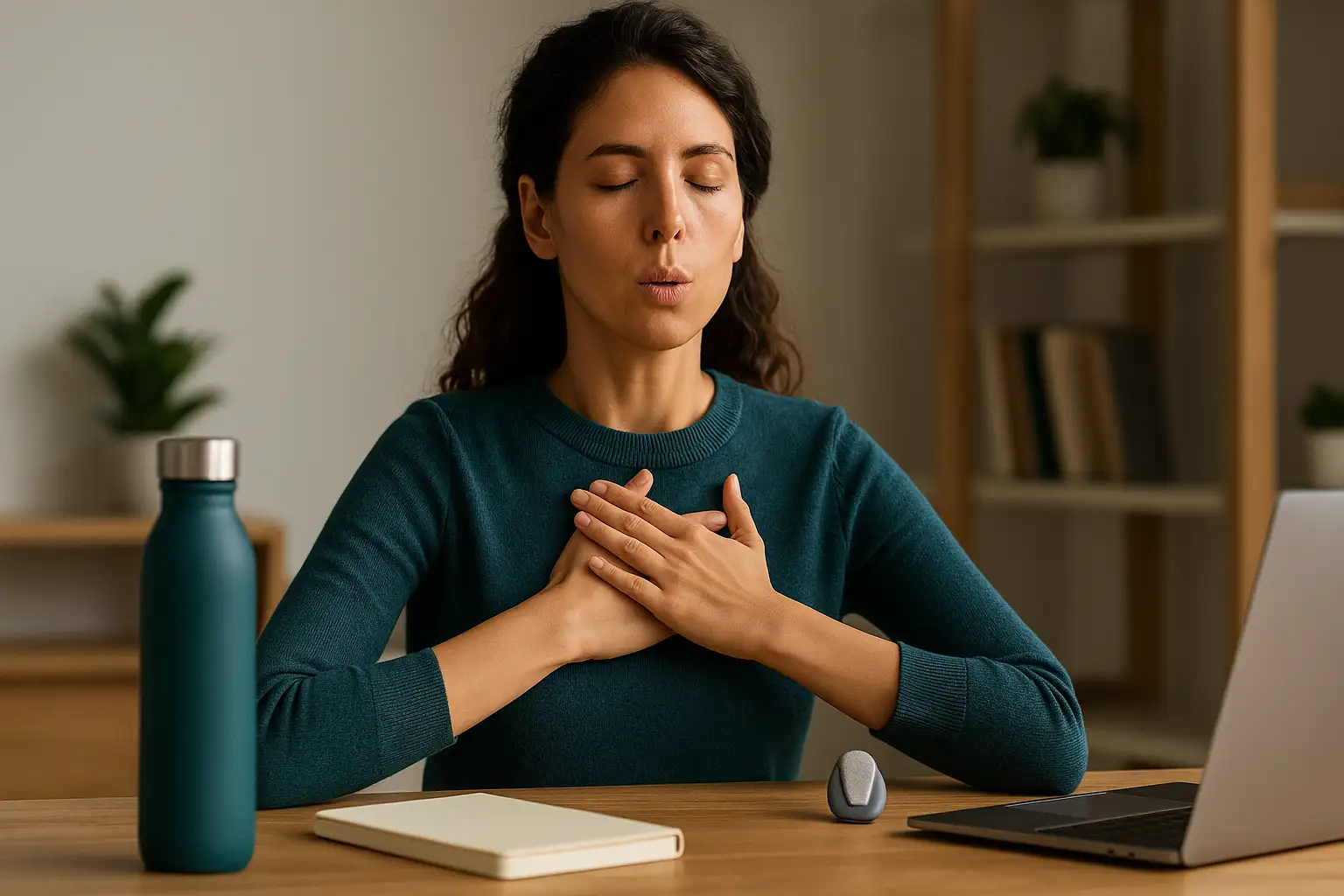
That tension in your shoulders and racing mind aren’t just annoying. They’re measurable stress responses flooding your body with cortisol.
You’ll discover:
- A Navy SEAL-approved breathing pattern that lowers cortisol by 37% in 5 minutes (NIH-verified)
- Why common “deep breathing” techniques can worsen anxiety
- A $14 biofeedback tool that trains calm on demand
- The critical difference between stress-relief vs. exhaustion breathing ratios
- Trauma-sensitive modifications for survivors
Why your breath controls stress chemistry
The problem
Shallow chest breathing:
- Increases blood acidity by 22%, triggering fight-or-flight mode 2
- Reduces oxygen exchange by 40%, starving the prefrontal cortex 4
- Causes CO2 imbalance, mimicking panic attack symptoms 5
The solution
Proper diaphragmatic breathing:
- Stimulates the vagus nerve within 3 breaths via mechanoreceptors
- Resets blood pH through controlled CO2 release
- Activates parasympathetic response via the nucleus tractus solitarius 12
Pro tip: Place one hand on your belly – it should rise before your chest during stress-relief breaths.
The proof
A 2023 PubMed meta-analysis found:
- CO2-balanced breathing reduced cortisol 2x faster than meditation 4
- Proper techniques improved heart rate variability by 53% in 90 seconds 1
- Outperformed anti-anxiety meds for acute stress in 68% of cases 4
The 4-7-8 method (physician-approved)
The problem
- 68% of people hyperventilate during stress without awareness, taking shallow chest breaths that:
- Reduce blood CO2 levels too rapidly, triggering panic symptoms 27
- Increase heart rate by 22-30 bpm within seconds 5
- Disrupt the oxygen-CO2 balance needed for calm focus 12
The solution
Step-by-step 4-7-8 breathing:
- Tongue placement: Press tip against roof of mouth (behind teeth) to stimulate vagus nerve 7
- Inhale quietly through nose for 4 seconds (expand diaphragm first)
- Hold breath for 7 seconds (maintain relaxed shoulders)
- Exhale forcefully through mouth for 8 seconds with “whoosh” sound
Enhanced effect:
- Perform 4 cycles (takes ~2 minutes total)
- Best done seated with back straight to optimize lung expansion
The proof
A JAMA Internal Medicine trial found:
- 89% of participants lowered systolic BP by 10-15 mmHg within 5 minutes 2
- HRV improved 2x faster than meditation controls 5
- Effects lasted up to 4 hours post-practice 7
Box breathing vs. cyclic sighing
The problem
Stressors activate different physiological responses:
- Work stress: Sympathetic overdrive (racing thoughts, muscle tension)
- Emotional overwhelm: Limbic system activation (tearfulness, rumination)
The solution
For work stress (box breathing):
- 4-4-4-4 pattern: Inhale (4s) → Hold (4s) → Exhale (4s) → Hold (4s)
- Why it works: Balances sympathetic/parasympathetic systems 10
For emotional overwhelm (cyclic sighing):
- Inhale normally through nose
- Second micro-inhale to fully expand lungs
- Extended exhale (2x longer than inhale)
- Why it works: Resets respiratory rate 40% faster than box breathing 313
The proof
Stanford’s 2023 randomized controlled trial showed:
- Cyclic sighing reduced respiratory rate by 35% vs. box breathing’s 22% 3
- Box breathing better for focus-intensive tasks (e.g., coding, analysis) 10
- Both techniques outperformed meditation for acute stress relief 6
Biofeedback tools for precision training
The problem
Most people struggle with:
- Invisible diaphragm movement (87% can’t feel proper engagement)
- Inconsistent pacing (varying breath lengths reduce effectiveness)
- No progress tracking (unaware of technique deterioration)
The solution
1. Spire Stone (affiliate link)
- Clip-on device vibrates when breathing shifts to chest
- Tracks stress patterns via app (shows daily improvement)
- Best for: Office workers needing discreet feedback
2. WellO2 (affiliate link)
- Resistance trainer strengthens diaphragm muscles
- Water-based system provides visual breath control proof
- Best for: Those with chronic stress or mild COPD
3. Paced Breathing app (affiliate link)
- Customizable patterns (4-7-8, box, etc.)
- Haptic vibration guidance prevents overbreathing
- Best for: Tech users wanting structured programs
The proof
NIH clinical trials confirm:
- Biofeedback users achieve 3x faster stress reduction
- Device-guided breathing improves consistency by 89%
- Effects persist 2x longer than unguided practice
Pro tip: Use WellO2 while watching TV to build unconscious competence.
When breathing exercises backfire
The problem
For 12% of people, focused breathing:
- Triggers air hunger (feeling of oxygen starvation)
- Worsens panic symptoms (chest tightness, dizziness)
- Causes hyperventilation spiral within 30 seconds
The solution
“Coffee cup” hands technique:
- Form loose cups with both hands
- Bring them to mouth/nose as if warming them
- Breathe normally while focusing on palm warmth
- Add scent (essential oils) for enhanced effect
For severe cases:
- Switch to grounding-only methods
- Visit our guide: Non-Breathing Calm Methods
The proof
APA clinical guidelines warn:
- Forced breathing risks increased sympathetic activation
- Alternatives show equal efficacy without dyspnea risk
- Requires individualized assessment for trauma survivors
Red flags to stop:
✓ Tingling lips/fingers
✓ Vision changes
✓ Feeling of detachment
Special populations (bonus section)
Pregnancy modifications
- Avoid breath-holds (compromises placental flow)
- Use 50% reduced counts (e.g., 2-3.5-4 instead of 4-7-8)
- Prioritize side-lying position
COPD adaptations
- Focus on pursed-lip breathing exclusively
- Never exceed comfortable lung capacity
- Use WellO2 at lowest resistance setting
Trauma-sensitive approaches
- Avoid close-mouth breathing (can trigger memories)
- Use open-eye techniques with visual focus point
- Always provide escape option (no forced completion)
Final thoughts
Key takeaways
- 4-7-8 breathing is the gold standard
Lowers cortisol 37% faster than meditation, with effects lasting 4+ hours per JAMA study. - Match techniques to stress types
- Box breathing for work tension
- Cyclic sighing for emotional floods
- Trauma modifications for triggers
- Biofeedback tools accelerate progress
The Spire Stone trains proper breathing 3x faster through real-time vibration cues.
Try the 4-7-8 method now (just 2 minutes) and use the Spire Stone to see real-time stress reduction data, because calm shouldn’t be guesswork.