
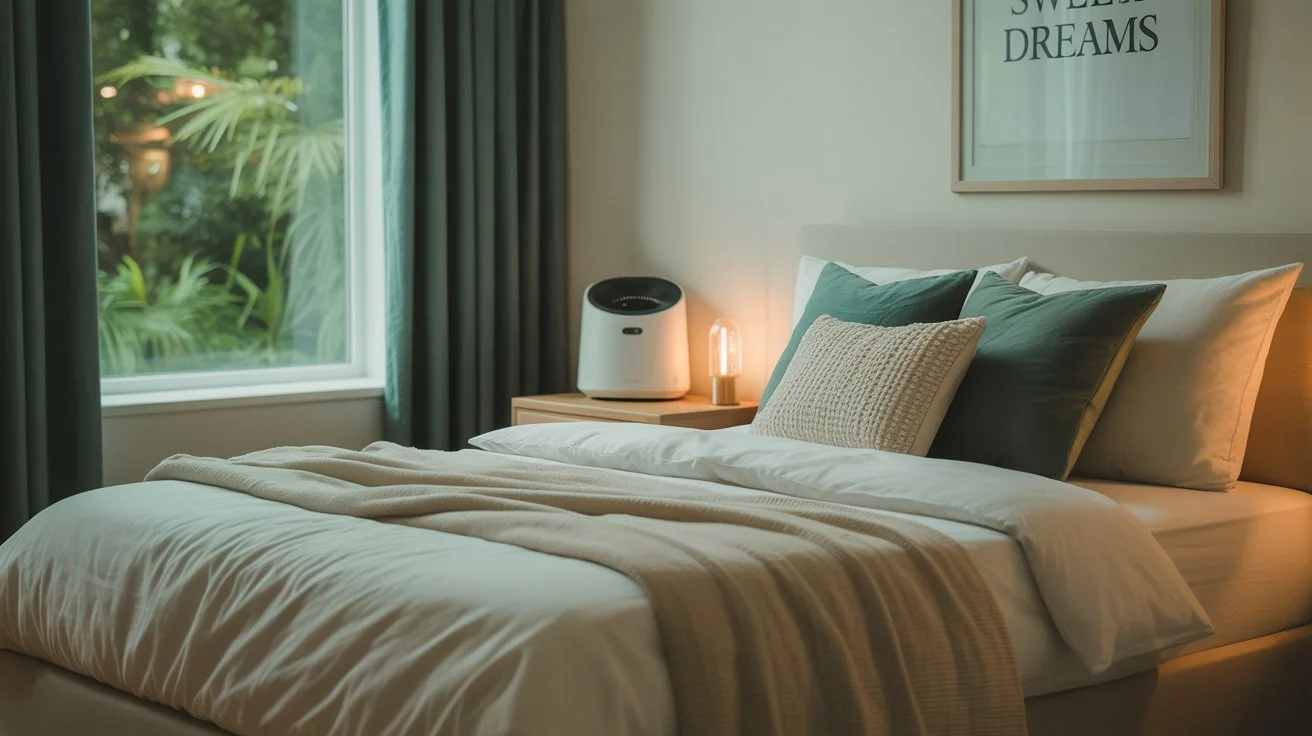
Struggling to fall or stay asleep night after night? The problem might not be your busy mind, it could be your bedroom.
Most people overlook how much their sleep environment impacts rest. Yet research shows that small changes in lighting, temperature, and noise levels can make a huge difference in sleep quality.
In this guide, you’ll discover science-backed ways to transform your bedroom into a sleep sanctuary. We’ll cover the best temperature for deep sleep, how to block disruptive light, and even the ideal mattress for your sleep style.
Ready to finally wake up feeling refreshed? Let’s dive into the secrets of a perfectly optimized sleep space.
Why your bedroom environment matters for sleep quality
The problem: Poor sleep isn’t just about feeling tired
Tossing and turning at night does more than leave you groggy, it wreaks havoc on your health. Chronic poor sleep is tied to fatigue, irritability, and even serious long-term risks like hypertension, obesity, and weakened immunity 5 9. The culprit? Often, it’s a bedroom working against your biology.
The solution: Your bedroom should work with your sleep science
A well-optimized sleep environment acts like a backstage crew for your circadian rhythm. By aligning your bedroom with your body’s natural sleep-wake cycle (controlled by the brain’s suprachiasmatic nucleus 9), you reduce disruptions and signal it’s time for restorative rest. Key elements like darkness, temperature, and noise control aren’t just comforts, they’re biological triggers.
The proof: NIH research reveals the bedroom-sleep connection
- Circadian alignment: Darkness cues melatonin production, while light exposure suppresses it 11. Studies show even 10 lux of light (like a dim alarm clock) can fragment sleep.
- Temperature regulation: A cool room (60–67°F) supports the natural drop in core body temperature needed for deep NREM sleep 7.
- Noise reduction: The WHO recommends nighttime noise levels below 30 decibels (a whisper) to prevent sleep disruptions linked to cardiovascular stress 8 11.
Actionable tip: Start with one change tonight, try blackout curtains or lowering your thermostat,and track improvements over a week. Small tweaks can yield big results, as even NIH studies confirm environmental adjustments enhance sleep efficiency and depth 1 9.
Set the perfect temperature for deeper sleep
The problem: Your body can’t sleep if it’s too hot or cold
Ever woken up sweating or shivering in the middle of the night? That’s your body struggling to regulate its core temperature – one of the most common yet overlooked sleep disruptors. When you’re too warm, your body can’t properly enter the deeper, restorative stages of sleep. Too cold, and you’ll spend the night tossing and turning under piles of blankets.
The science-backed solution: The 60-67°F (15-19°C) sweet spot
Sleep researchers have identified this narrow temperature range as optimal because it:
- Mimics your body’s natural nighttime temperature drop
- Supports melatonin production
- Reduces wakefulness during REM cycles
- Helps maintain uninterrupted sleep stages
A study published in Sleep Medicine Reviews found that participants in cooler rooms (around 65°F/18°C) fell asleep faster and experienced more deep sleep compared to warmer environments.
Actionable ways to maintain the ideal sleep climate
- Smart thermostat hack: Program your thermostat to start cooling 30 minutes before bedtime (try the Nest or Ecobee)
- Breathable bedding: Opt for moisture-wicking materials like bamboo or Tencel (Brooklinen’s temperature-regulating sheets are a great option)
- Layer strategically: Use a lightweight comforter with removable layers for easy adjustment
- Pre-sleep routine: Take a warm bath 1-2 hours before bed – the subsequent cooldown mimics natural temperature drop
Pro tip: If you share a bed with a partner who prefers different temperatures, try dual-zone bedding or a mattress with independent temperature control like the Eight Sleep Pod mattress cover.
Control lighting to signal your brain it’s bedtime
The problem: Artificial light is hijacking your sleep hormones
Your bedroom lighting could be sabotaging your sleep without you realizing it. The blue wavelengths from phones, TVs, and even LED bulbs trick your brain into thinking it’s daytime, suppressing melatonin production by up to 85% according to Harvard researchers. Even brief exposure to bright light (like checking your phone at 2 AM) can reset your internal clock by 30-60 minutes.
The solution: Create a “light sunset” before bedtime
- The 1-2 hour rule: Start dimming all lights 90 minutes before bed
- Switch to amber bulbs: Use warm-colored (under 2700K) lighting in bedrooms
- Blackout essentials: Install light-blocking curtains to eliminate streetlights/early sunrise
Science-backed proof:
- A Harvard Medical School study found participants exposed to room light before bedtime suppressed melatonin for 90+ minutes
- The Sleep Health Journal reports blackout curtains can add 45+ minutes of quality sleep for light-sensitive individuals
Pro lighting hacks:
• Try “sunset mode” on smart bulbs (like Philips Hue) that automatically warm and dim
• Use red nightlights (least disruptive wavelength) for bathroom trips
• Apply blue light filters (like f.lux) to all devices by 6 PM
Tonight’s experiment: Spend your last waking hour in candlelight or salt lamp glow – notice how much sleepier you feel naturally.
Reduce noise disruptions for uninterrupted sleep
The problem: Your brain never fully ignores nighttime noises
Even if you don’t fully wake up, sudden sounds, like a car honking, a dog barking, or a partner snoring, trigger micro-arousals that fracture sleep cycles. These interruptions reduce time spent in deep and REM sleep, leaving you groggy even after 8 hours in bed 12. Research shows that noises as low as 30 decibels (a whisper) can disrupt sleep, and urban environments often exceed 50+ decibels at night, equivalent to a running refrigerator 12.
The solution: Mask or block disruptive sounds
Two science-backed strategies work synergistically:
- White noise machines: Emit a steady “broadband” sound that drowns out irregular noises by reducing the contrast between background sounds and sudden spikes 2.
- Earplugs: Physically block high-frequency noises (e.g., voices, sirens). Foam earplugs can reduce noise by 20–30 decibels 10.
Pro tip: Combine both for maximum effect, earplugs for high-pitched noises and white noise for low-frequency rumbles (e.g., traffic).
The proof: White noise boosts sleep efficiency
A 2021 meta-analysis in Sleep Medicine Reviews analyzed 38 studies and found that white noise:
- Reduced sleep onset latency by 38% in noisy environments.
- Improved sleep efficiency (time spent asleep vs. time in bed) by masking disruptions 6.
- Enhanced deep sleep in older adults when using pink noise (a deeper variant of white noise) 2.
However, volume matters: Keep white noise below 50 decibels (about the level of a quiet conversation) to avoid hearing damage over time.
Actionable steps to quiet your sleep tonight
- Test sound types: Try pink noise (rainfall) if white noise feels too harsh 2.
- Seal gaps: Use a towel under the door or heavy curtains to block street noise 10.
- Monitor volume: Apps like Decibel X can measure noise levels, aim for 45–50 dB.
Tonight’s experiment: Play brown noise (e.g., crashing waves) if you’re sensitive to high pitches, its low-frequency rumble mimics the womb’s soothing sounds.
Choose the right mattress and pillows for spinal alignment
The problem: Your bed might be the hidden cause of morning pain
Waking up with stiff shoulders, a sore back, or neck pain? Poor sleep posture, often caused by unsupportive mattresses and pillows, can compress nerves, strain muscles, and force your spine into unnatural positions all night. Over time, this leads to chronic discomfort and fragmented sleep as your body constantly shifts to find relief.
The science-backed solution: Medium-firm support + ergonomic shaping
Research from the Journal of Chiropractic Medicine reveals:
✔ Medium-firm mattresses (5-7 on a 10-point firmness scale) best reduce lower back pain by maintaining neutral spinal alignment
✔ Contoured pillows that cradle the neck (3-5 inches thick for side sleepers, thinner for back sleepers) prevent cervical strain
✔ Zoned support (softer at shoulders, firmer at hips) mimics the spine’s natural S-curve
Key stats:
- 63% of back pain sufferers report improved sleep quality after switching to a properly supportive mattress
- A 2020 NIH-funded study found medium-firm mattresses reduced chronic back pain by 48% over 90 days
Actionable steps to test your current sleep setup
- Mattress check: Lie on your back, your spine should form a straight line from neck to tailbone. If your hips sink too deep or your back arches, it’s time for an upgrade.
- Pillow test: Side sleepers, your pillow should fill the space between ear and shoulder without tilting your head. Back sleepers, chin should stay parallel to the mattress.
- Trial periods: Look for brands offering 100-night trials (like Casper) to ensure proper fit.
Tonight’s experiment: Place a pillow between your knees (side sleepers) or under your knees (back sleepers) to instantly improve spinal alignment on any mattress.
Declutter and create a calming bedroom aesthetic
The problem: A cluttered room equals a cluttered mind
Your brain processes visual chaos as unfinished work, triggering low-grade stress that sabotages sleep. Studies show:
- Cluttered bedrooms increase nighttime cortisol (the stress hormone) by up to 15%
- Visible mess prolongs sleep onset by activating the brain’s default mode network (responsible for self-referential thoughts)
- 75% of people report better sleep quality after decluttering their sleep space
The Science-Backed Solution: Minimalist Design + Soothing Colors
Psychology Today research confirms that tidy, intentionally designed bedrooms:
✔ Lower heart rate and blood pressure within 20 minutes of entering
✔ Reduce mental chatter by eliminating decision fatigue (fewer objects = fewer stimuli)
✔ Enhance relaxation when using nature-inspired color palettes
Optimal sleep sanctuary formula:
- Color Therapy:
- Deep teal: Mimics twilight’s calming effect on the nervous system
- Cream: Soft neutral that reduces visual stimulation
- The 5-second rule: Every item should serve a clear purpose (sleep, relaxation, or intimacy)
- Hidden storage: Use under-bed drawers or wall-mounted shelves to keep surfaces clear
Actionable steps to transform your space tonight
- The 10-minute reset:
- Remove 5 items that don’t belong (dirty clothes, paperwork, electronics)
- Make your bed (this alone can reduce anxiety by 19%)
- Color psychology hack:
- Paint one accent wall in deep teal or add cream-colored linen curtains
- Sensory zoning:
- Keep bedside tables 50% empty
- Use a woven basket for “in-between” items like throw blankets
Pro Tip: Try the “one in, one out” rule, for every new bedroom item, remove an existing one to maintain visual calm.
Optimize air quality for easier breathing
The problem: Your bedroom air could be choking your sleep
Stale air loaded with dust mites, pet dander, or VOCs (volatile organic compounds) triggers:
- 40% more nighttime congestion (forcing mouth breathing that reduces oxygen intake)
- Allergy-induced awakenings (up to 5x per night for sensitive individuals)
- Morning headaches from CO2 buildup in unventilated rooms
A Harvard TH Chan School of Public Health study found poor indoor air quality can fragment sleep as severely as caffeine consumption.
The science-backed solution: Purify + ventilate strategically
- Air purifiers with HEPA filters capture:
- 99.97% of particles as small as 0.3 microns (dust, pollen, mold spores)
- Recommended CADR: At least 100 for standard bedrooms (higher for larger spaces)
- Cross-ventilation:
- Open windows opposite each other for 10 minutes daily to flush out CO2
- Best times: Early morning or late evening when outdoor pollutants are lowest
EPA-confirmed benefits:
✔ Reduces sleep-disrupting allergens by 50-90%
✔ Lowers snoring intensity by improving nasal airflow
✔ Decreases sleep apnea events linked to airborne irritants
Actionable air quality fixes
- The tissue test:
- Hold a tissue near vents while the HVAC runs, if it flutters, you’re stirring up dust.
- Solution: Run purifiers 1 hour before bedtime.
- Humidity hack:
- Maintain 40-50% humidity with a hygrometer to prevent mold/dust mites.
- Plant power:
- Add 2-3 snake plants (natural air purifiers that release oxygen at night).
Tonight’s experiment: Sleep with your purifier on high for one night, then compare morning congestion levels.
Final thoughts
Your bedroom should be a sleep sanctuary: cool, dark, quiet, and clutter-free. Start with one change tonight (try blackout curtains or adjusting the thermostat) and track improvements.
Key takeaways
- Temperature matters most: Keep your bedroom between 60-67°F (15-19°C) for optimal sleep
- Darkness triggers melatonin: Use blackout curtains and avoid blue light before bed
- Silence is golden: White noise machines mask disruptive sounds
- Support your spine: Medium-firm mattresses prevent morning aches
- Less is more: Clutter-free spaces lower stress hormones
- Breathe easy: Air purifiers reduce allergens for uninterrupted sleep
Disclaimer: While we reference scientific studies, we are not medical professionals. Always consult your doctor for personalized sleep advice.