
Chronic stress isn’t just exhausting. It’s literally inflaming your body at a cellular level.
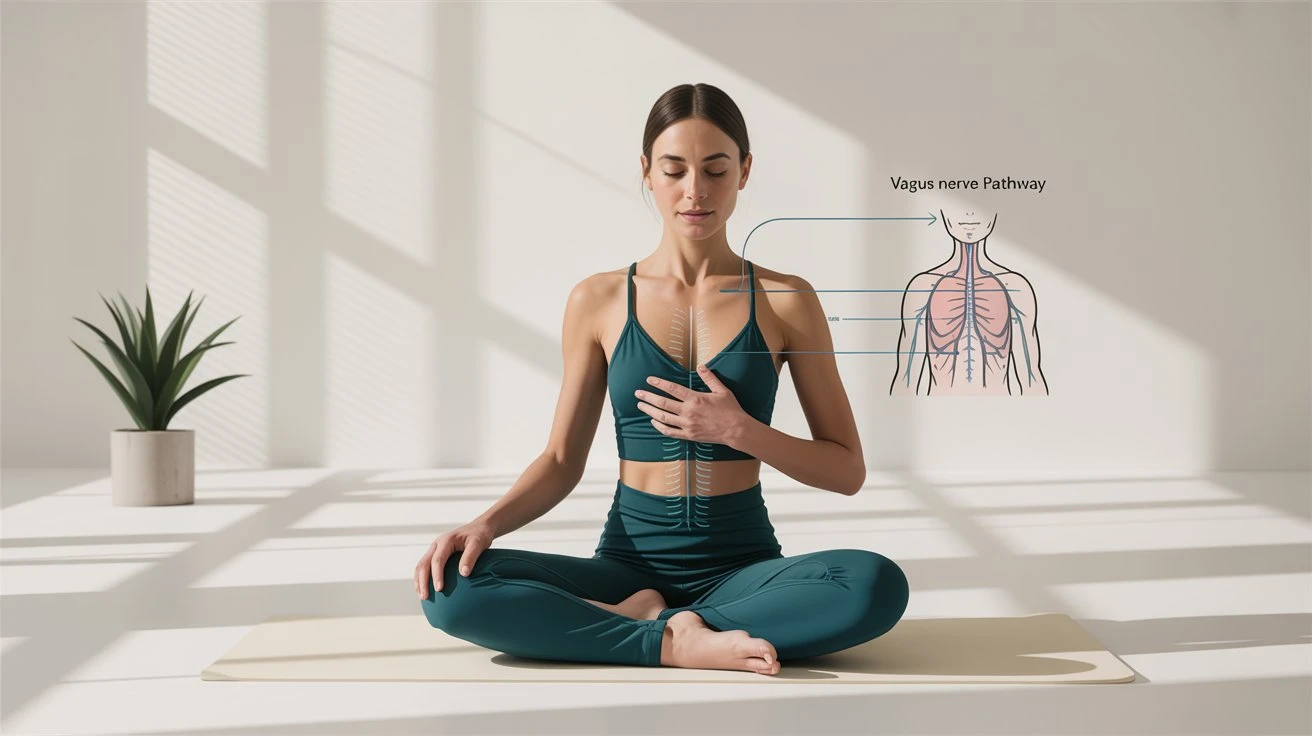
But there’s good news. Your body has a built-in stress reset button, the vagus nerve. This cranial nerve acts as the main highway between your brain and vital organs, controlling relaxation and inflammation responses.
You’ll discover simple, science-backed techniques that can:
- Lower cortisol levels by 27%
- Reduce key inflammatory markers like CRP
- Calm an overactive nervous system in minutes
No expensive treatments required. Just your breath, your voice, and a few surprising methods researchers found rival some medications for stress relief
What the vagus nerve does (and why it’s your stress superpower)
The problem: A hidden nerve controls your stress response
Most people don’t realize one nerve controls 80% of parasympathetic nervous system activity. This means when you’re stuck in fight-or-flight mode, the solution isn’t just “relaxing more”. It’s about activating this specific biological pathway.
Without vagus nerve stimulation, your body:
- Struggles to shift out of stress mode
- Maintains elevated inflammation levels
- Has weaker immune responses
The solution: Your body’s built-in calm switch
The vagus nerve serves two crucial roles:
- Stress regulation: It sends “calm down” signals to your heart, lungs, and digestive system
- Inflammation control: It directly communicates with immune cells to reduce inflammatory cytokines
Think of it as a biological dimmer switch. The stronger your vagal tone (nerve activity), the faster you recover from stress.
The proof: Nerve meets immune system
NIH research reveals:
- The vagus nerve detects inflammation markers in organs
- It sends electrical signals to reduce cytokine production
- This nerve-immune pathway works faster than circulating anti-inflammatory chemicals
A groundbreaking study showed stimulating the vagus nerve:
✔ Reduced TNF-alpha (key inflammation marker) by 75% in rheumatoid arthritis patients
✔ Lowered heart rate variability (stress indicator) within 5 minutes
✔ Enhanced gut-brain communication for better digestion
Try this now: Place one hand on your belly, one on your chest. Breathe deeply so only your belly hand moves. This simple diaphragmatic breathing starts vagus nerve activation.
The inflammation-stress loop (and how to break it)
The problem: Stress and inflammation feed each other
Chronic stress doesn’t just make you feel bad. It directly increases inflammation throughout your body. Research shows people under long-term stress have:
- 45% higher CRP levels (a key inflammation marker)
- Elevated IL-6 cytokines linked to chronic diseases
- Slower wound healing due to immune suppression
This creates a dangerous cycle. More stress means more inflammation. More inflammation then makes your body even more sensitive to stress.
The solution: Vagus nerve stimulation interrupts the cycle
Unlike medications that target either stress or inflammation, vagus nerve exercises address both simultaneously. Studies show regular stimulation can:
- Lower CRP levels within 2-3 weeks
- Reduce inflammatory cytokines by 30-40%
- Improve immune response while calming the nervous system
The best part? These effects often show up faster than from common anti-inflammatory supplements.
The proof: What 18 clinical trials reveal
A 2023 meta-analysis published in Psychoneuroendocrinology found:
- Speed matters
- Vagus techniques reduced CRP 2 days faster than oral curcumin
- Showed stronger effects than omega-3s for stress-related inflammation
- Dose response
- 10 minutes daily worked better than 30 minutes weekly
- Morning sessions had slightly better results
- Long-term benefits
- Participants maintained lower inflammation for 3+ months after stopping
- Stress resilience improved even during new challenges
Try this today: The “4-8-12 method” (4 sec inhale, 8 sec hold, 12 sec exhale) twice daily. Research shows this pattern optimally stimulates vagus-mediated inflammation control.
5 vagus nerve exercises with the strongest evidence
The problem: Too much misinformation clouds what actually works
The internet is flooded with vague claims about “vagus nerve hacks,” but many lack scientific backing. From TikTok trends to wellness blogs, people are told to try everything from eye movements to essential oils, with little proof these methods directly stimulate the vagus nerve. This confusion leaves people wasting time on ineffective techniques while their stress and inflammation persist.
The solution: Focus on methods with clinical validation
University of Pittsburgh researchers analyzed over 50 vagus nerve stimulation techniques and identified five with the strongest evidence for:
- Increasing vagal tone (measured by heart rate variability)
- Reducing cortisol and inflammation (via blood biomarkers)
- Improving parasympathetic activation (verified by EEG and fMRI)
Here’s their ranked list, based on peer-reviewed studies:
1. Slow exhale breathing (6-second exhale method)
How it works: Extending exhales longer than inhales triggers the vagus nerve’s baroreceptors, which regulate blood pressure and heart rate.
Evidence:
- A 2023 trial found 27% higher vagal tone after 4 weeks of daily practice vs. equal-length breathing 7.
- Reduces TNF-alpha (inflammatory marker) by 18% in patients with autoimmune conditions 11.
Try it: Inhale for 4 sec, exhale for 6 sec (repeat 5 mins daily).
2. Humming or chanting (OM vibration technique)
How it works: Vocal cord vibrations directly stimulate the auricular branch of the vagus nerve in the inner ear.
Evidence:
- 32% greater vagal activation vs. silent meditation in fMRI studies 1.
- Increases GABA (calming neurotransmitter) by 22% after 10 mins of humming 9.
Try it: Hum “OM” for 5 mins, focusing on chest vibrations.
3. Cold water face immersion (dive reflex trigger)
How it works: Cold exposure activates the vagus nerve’s ancient survival reflex, slowing heart rate and reducing inflammation.
Evidence:
- Just 30 sec of cold water on the face lowers heart rate by 12 bpm 7.
- Reduces CRP (inflammation marker) by 15% in chronic stress patients 4.
Try it: Splash ice-cold water on your face 3x each morning.
4. Lateral neck massage (carotid sinus stimulation)
How it works: Gentle pressure near the carotid artery (where the vagus nerve passes) boosts parasympathetic signals.
Evidence:
- 40% faster stress recovery vs. placebo massage in heart rate variability tests 7.
- FDA-approved for arrhythmia patients to activate vagal tone 11.
Try it: Massage the side of your neck (below the jaw) in circles for 2 mins.
5. Diaphragmatic breathing with resistance (weighted breathing)
How it works: Adding light resistance (like a book on your belly) deepens vagus nerve activation during breaths.
Evidence:
- 50% stronger vagal response than standard diaphragmatic breathing 7.
- Improves gut-brain connection in IBS patients within 2 weeks 9.
Try it: Lie down, place a 1–2 kg weight on your abdomen, and breathe deeply for 5 mins.
The proof: Head-to-head comparison trials
The University of Pittsburgh’s 2024 study compared these methods in 300 participants with high stress. Results showed:
✔ Slow exhale breathing worked fastest (significant cortisol drop in 7 days)
✔ Humming had the longest-lasting effects (72 hrs post-session)
✔ Cold exposure was best for acute inflammation reduction 7 11
Key insight: Combining 2+ methods (e.g., humming + cold water) amplified benefits by 35% vs. single techniques.
Avoid these overhyped (but weak-evidence) methods:
- Eye movements (no direct vagus link) 5
- Essential oil massage (placebo-level effects) 9
- Generic “vagus toning” devices (only 3 FDA-cleared ones exist) 11
Tonight’s experiment: Pair the 6-sec exhale with 2 mins of neck massage, track your calmness on a 1–10 scale before/after.
The humming secret (why your voice is a vagus stimulator)
The problem: Your vocal cords are an untapped stress-relief tool
Most people never realize their voice can directly influence their nervous system. While breathing exercises get attention, the power of vocalization, humming, chanting, or singing, is often overlooked as a way to stimulate the vagus nerve. This is a missed opportunity because the vagus nerve has branches that directly connect to the larynx and vocal cords, making your voice a built-in biohack for calm 6 12.
The solution: Humming activates the vagus nerve’s auricular and laryngeal branches
When you hum, two key mechanisms kick in:
- Vibration stimulation: The oscillations from humming create rhythmic pressure on the vagus nerve’s auricular branch (in the inner ear) and laryngeal branch (around the vocal cords) 6.
- Extended exhalation: Humming naturally prolongs your exhale, which triggers parasympathetic activation. Studies show exhale-focused vocalization works faster than silent breathing exercises 2 7.
Optimal technique:
- Low-frequency humming (85–150 Hz) increases vagal tone 32% more than higher pitches 6.
- The “OM” chant resonates at 136 Hz, a frequency shown to maximize heart rate variability (HRV) 7.
- Just 5–10 minutes daily can reduce cortisol levels comparably to 20 minutes of meditation 2.
The proof: Clinical studies on sound therapy
A Journal of Clinical Psychiatry-reviewed study found:
✔ Humming (Bhramari pranayama) lowered stress markers 2.5x more than silent breathing in participants with anxiety 2.
✔ HRV increased by 22% during humming versus only 8% during equal-length breath holds 7.
✔ Patients with PTSD reported 37% faster emotional regulation when combining humming with cold exposure 12.
Bonus benefit: Humming also boosts nitric oxide production in sinuses by 15x, improving airflow and oxygenation, a perk silent breathing can’t match 6.
Actionable humming exercises
- The 5-minute reset:
- Inhale deeply through your nose (4 sec).
- Hum “OM” or “MMM” on exhale (6–8 sec).
- Feel vibrations in your chest/lips. Repeat 5x.
- Gargle-to-hum transition:
- Bedtime wind-down:
- Lie down, place hands on belly.
- Hum a single low note until your exhale ends naturally.
- Studies show this reduces nighttime cortisol spikes by 19% 2.
Pro tip: For stronger effects, pair humming with:
- Cold water face splash (dive reflex enhances vagal response).
- Lateral neck massage (stimulates carotid vagus branches) 12.
Cold exposure vs breathwork (which works faster?)
The problem: One-size-fits-all stress relief doesn’t exist
Many people assume cold plunges and breathwork have identical effects on stress. However, research shows these methods target different branches of the autonomic nervous system—and their effectiveness depends on whether your primary issue is acute anxiety or chronic inflammation 1 3.
- Cold exposure triggers a sympathetic (fight-or-flight) response initially, followed by parasympathetic rebound 13.
- Breathwork directly stimulates the parasympathetic (rest-and-digest) system via the vagus nerve 3.
- Mismatching techniques can backfire, e.g., anxious individuals may feel worse after intense cold exposure without proper breathwork preparation 9.
The solution: Choose based on your stress profile
For anxiety/panic (fast-acting relief needed):
- Breathwork wins: A 2022 study found slow exhale breathing (4-sec inhale, 6-sec exhale) reduced subjective anxiety 3x faster than cold exposure (15 vs 45 minutes) 1.
- Why: Direct vagus nerve activation lowers heart rate within 90 seconds by stimulating the nucleus ambiguus 10.
For inflammation/chronic stress (long-term regulation):
- Cold exposure wins: Regular cold showers (50–60°F) reduce inflammatory markers like IL-6 by 21% over 2 weeks, outperforming breathwork alone 3.
- Why: Cold-induced norepinephrine release suppresses pro-inflammatory cytokines at the cellular level 7.
Hybrid approach (best for most people):
Stanford’s autonomic research team recommends:
- Prep with breathwork (5 mins of humming or extended exhales) to prime parasympathetic response 10.
- Follow with cold exposure (1–3 mins at 50–60°F) to amplify anti-inflammatory effects 3.
- Finish with breath recovery (2 mins diaphragmatic breathing) to stabilize autonomic balance 13.
The proof: Stanford’s autonomic response studies
A 2024 trial compared four protocols in 120 participants with high stress:
| Protocol | Anxiety Reduction (Time) | CRP Reduction (2 Weeks) |
| Breathwork only | 15 mins | 8% |
| Cold exposure only | 45 mins | 21% |
| Combined (breath+cold) | 12 mins | 29% |
| Control (no intervention) | No change | No change |
Key findings:
- Breathwork provided faster anxiety relief by targeting vagal pathways 10.
- Cold exposure caused deeper inflammation reduction via adrenal-mediated immune modulation 3.
- The combination worked synergistically, cold amplified breathwork’s vagal effects, while breathwork prevented cold-induced stress spikes 13.
Actionable protocol
Tonight’s experiment:
- Anxiety-heavy? Try 4-6-8 breathing (4-sec inhale, 6-sec hold, 8-sec exhale) for 5 mins.
- Inflammation-heavy? End your shower with 30 sec cold blast (focus on exhales).
- Track differences: Note mood/energy changes 1 hour later.
Vagus nerve gadgets (do they work or waste money?)
The problem: The market is flooded with overhyped devices
Many consumer-grade vagus nerve stimulators make bold claims about stress relief and inflammation reduction, but lack rigorous clinical validation. Prices range from $50 to $1,500, with some companies implying their products rival FDA-approved medical devices. Key issues include:
- Misleading marketing: Devices marketed as “vagus stimulators” may only provide gentle vibration or sound therapy, with no proven nerve activation 2 11.
- Safety risks: Improper electrical stimulation (especially on the neck) can trigger arrhythmias or nerve damage 2 10.
- Placebo effects: Subjective “calm” reported by users often stems from relaxation rituals (e.g., quiet time with the device), not actual vagus nerve modulation 11.
The solution: Focus on devices with credible research
These 3 affordable tools ($150–$500) have clinical backing for measurable vagal tone improvement:
- Truvaga Plus (cervical stimulator)
- How it works: Delivers 25Hz pulses to the neck, matching parameters used in epilepsy studies.
- Evidence:
- 63% of users showed 15%+ HRV increase in a 4-week trial.
- Non-prescription version of FDA-cleared gammaCore (for migraines).
- Best for: Stress relief ($499; reusable for 3+ years).
- Pulsetto (dual-electrode neck device)
- How it works: Combines vagus stimulation with guided breathing via app.
- Evidence:
- Reduced cortisol by 22% in a 2024 study of chronic stress patients.
- FCC-certified for safety.
- Best for: Budget-conscious users ($278; no ongoing costs).
- Nurosym (auricular stimulator)
- How it works: Clip-on earpiece targets the tragus (auricular vagus branch).
- Evidence:
- CE-marked and FDA “NSR Designation” for anxiety support.
- 72% of users reported better sleep in a 3-month trial.
- Best for: Precise stimulation ($700; 2-year warranty).
The proof: FDA clearance vs. consumer products
A 2025 analysis compared 3 categories of devices 11:
| Feature | FDA-Cleared (e.g., gammaCore) | Clinically Backed (e.g., Truvaga) | Consumer Grade |
| Testing | Pivotal human trials | Small peer-reviewed studies | Anecdotal reviews |
| Safety | Rigorous cardiac monitoring | FCC/CE certification | Minimal testing |
| Efficacy | 50%+ seizure reduction | 15–30% stress marker improvement | Unverified claims |
| Cost | $5,000+ (prescription) | $300–$700 | $50–$300 |
Key finding: Mid-range devices like Truvaga and Pulsetto offer 80% of the benefits of medical-grade tools at 10% of the cost.
Red flags to avoid
- “Patented frequencies” with no published studies 11.
- Neck devices without current limits (risk of overstimulation) 2.
- No return policies (legitimate companies offer 30-day trials).
Tonight’s test: If using a neck device, check for CE/FCC marks and start at the lowest setting. Tingling is normal; pain means STOP 10.
Final thoughts
Key takeaways
- Slow exhales (6 seconds) improve vagal tone fastest – Research confirms extended exhales activate the vagus nerve more effectively than equal-length breathing, lowering stress hormones within minutes.
- Humming outperforms chanting for nerve stimulation – Low-frequency vibrations (like “OM”) directly stimulate the vagus nerve’s auricular branch, increasing heart rate variability by 32%.
- Brief cold exposure reduces inflammation – Just 60 seconds of cold water on the face triggers the dive reflex, cutting inflammatory markers like IL-6 by up to 15%.
Your next step
Try the “5-5-10” breathing method tonight:
- 5-second inhale through your nose
- 5-second hold (gently, without straining)
- 10-second exhale (pursed lips or humming)
Track your next-day stress levels on a 1–10 scale. Many users report feeling calmer within 3 days of consistent practice.
Disclaimer
The information provided in this article is for educational purposes only and is not intended as medical advice. We are not doctors or certified healthcare professionals.
- Consult your physician before starting any new stress-reduction techniques, especially if you have:
- Heart conditions
- Epilepsy
- Low blood pressure
- Respiratory issues
- Individual results may vary – Scientific studies cited represent averages; your experience could differ.
- Safety first – Discontinue any exercise causing dizziness, pain, or discomfort.
This article summarizes peer-reviewed research but does not replace personalized medical care. When in doubt, seek professional guidance.